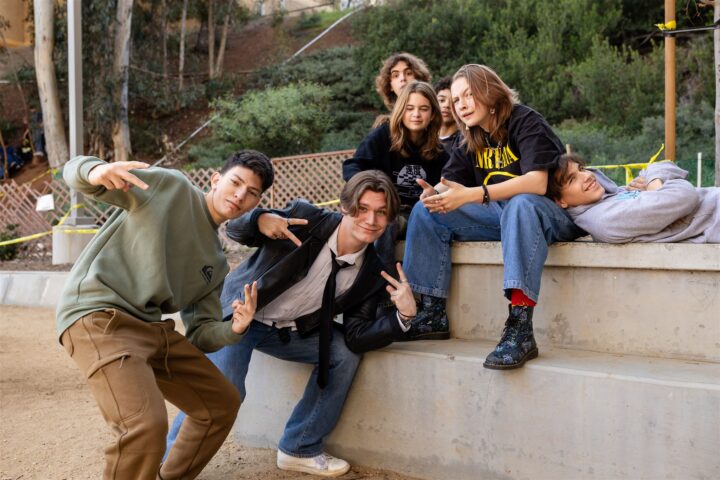
Middle school at Innovations Academy is anything but ordinary. We believe these three years are far more than a stepping stone, they’re where students begin to own their voice, develop real independence, and discover what they’re passionate about. Our small school means every student is known, supported, and challenged in a community that genuinely cares about who they’re becoming.
High expectations. Creative freedom. No meaningless homework. This is middle school done differently.
Our Approach to Learning
Our middle school program is rigorous, relevant, and real. It layers in increased independence, deeper inquiry, and real-world problem-solving. Students don’t just study the world, they engage with it.
Inquiry-Based Projects
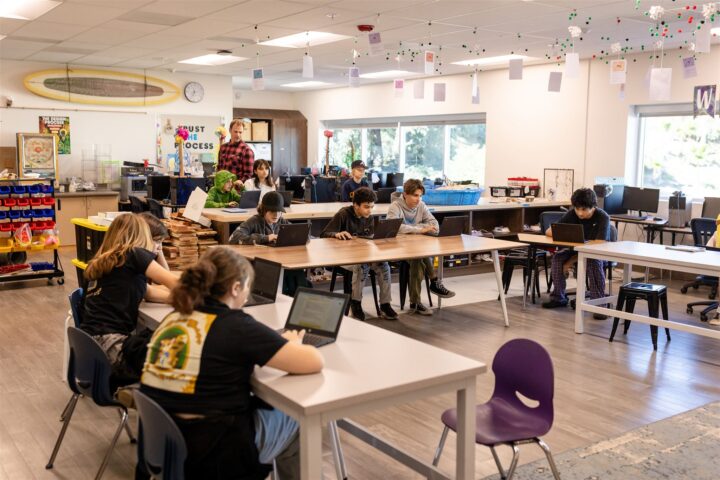
Students tackle complex, authentic questions through sustained projects like creating podcasts, designing food trucks, and studying astronomy overnight in the desert.
Voice & Self-Expression
From documentary filmmaking to public debate, our students learn to communicate ideas confidently and creatively across a wide range of mediums and audiences.
Independence with Support
Students practice real autonomy including access to our campus café for independent study, while trusted adults remain close, guiding and cheering them on.
Critical Thinking
We teach students how to think, not what to think. Socratic seminars, use of the Question Formulation Technique, collaborative research, and hands-on challenges build analytical skills for life beyond school.
Community Connections
Partnerships with local businesses, expert mentors, and community organizations bring real-world context to classroom learning throughout the year.
Social Emotional Learning
SEL is especially vital in middle school. Advisory sessions, team-building, and positive discipline help students navigate relationships, stress, and big emotions with skill.
Results by the Numbers
What Makes Our Middle School Unique
Students have access to a range of experiences that support independence, creativity, and connection. We intentionally connect our students to each other through Morning Meetings, Advisory and instructional techniques that foster group collaboration. Our emphasis on conflict resolution involves students in solving the problem in a way that builds understanding of themselves and others.
Campus Café
Middle school students use the campus café as a space for independent study, collaboration, and project work, helping them build responsibility and self-management skills.
Field Trips & Off-Campus Learning
Off-campus experiences are an important part of the program.
Highlights include:
– 6th grade overnight camp
– 7th grade overnight camp
– 8th grade astronomy trip with desert overnight
– National Parks trip at the end of 8th grade
– Additional day trips to museums, historical sites, and local programs
– Guest speakers who highlight the joys of learning content at high levelsHigh School Preparation
Students explore a range of high school options through visits, conversations, and guidance. By the end of 8th grade, students are prepared and informed about their next step and take it on as owners of their next step.
Monday Electives
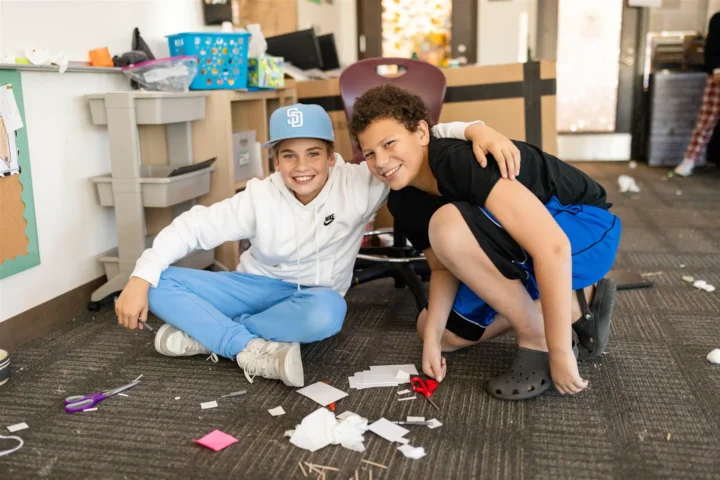
Weekly elective seminars let students explore interests beyond the core curriculum: cooking, short film studies, wood carving, strategy board games, candle dipping, beaded keychains, and mentoring younger students.
Team Building & Advisory
Twice a week, middle schoolers participate in team-building activities on mixed 6th-8th grade teams. Additional advisory sessions explore social-emotional topics relevant to the middle school experience.
Leadership & Events
Student voice matters here. Middle schoolers take the lead on school-wide events including the beloved Valentine’s Day Extravaganza, the annual Halloween Haunted House, and talent show.
Math That Connects to the Real World
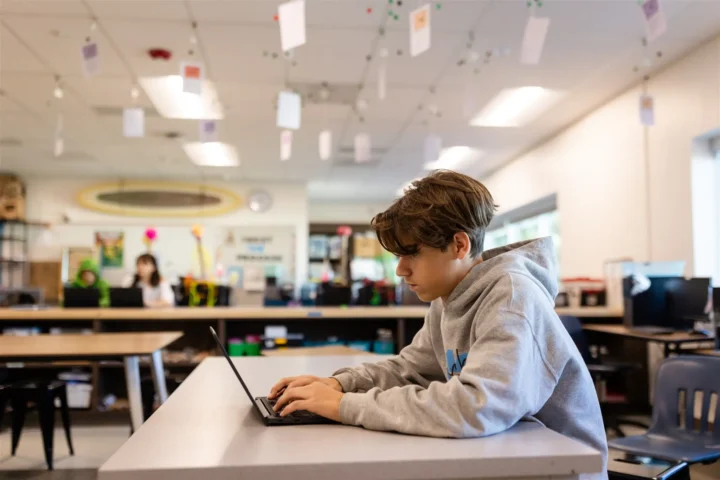
Our 6th–8th grade math program combines rigorous curriculum with visual, hands-on tools helping students build deep conceptual understanding alongside algebraic fluency.
All middle school students engage in a minimum of 75 minutes of math five days a week. Our core curricula are Illustrative Mathematics and Desmos — programs known for building genuine mathematical reasoning through collaborative problem-solving and visual representations.
Math Software Programs Used at I.A.
ST Math (spatial-temporal math)
Beginning in October 2013, our students have accessed the ST Math program. This is a research based, spatial-temporal visual learning mathematics software. Created to address the fact that children learn differently than schools have traditionally taught, our goal is to support our students to understand mathematical concepts, not just memorize algorithms.
Thinking Blocks
Thinking Blocks is an interactive tool that helps students model math word problems.
And more...
We use a plethora of useful resources such as Marcy Cook Puzzles, Logic Puzzles, Three Act Math Problems and Mountain Math
Enrichments & Foreign Language
Middle school students participate in a rich mix of Explorations classes taught by dedicated specialists. These programs develop creative, athletic, and academic breadth, often sparking lasting passions:
- Spanish
- Performing Arts
- Fine Art (2D & 3D)
- Environmental Science
- Engineering & Robotics
- Physical Education — soccer, baseball, net sports, football, and track & field
Facilities include a ceramics studio and a full performance space with stage lighting.
How We Assess Progress
Growth We Can See and Share
Our assessment approach reflects our values: students reflect on their growth, share their thinking, and build lifelong communication skills. Assessment goes beyond report cards and tests to value both student work and their ability to discuss their learning, with structures that support self-assessment and meaningful parental guidance.
Student Led Conferences
Each year, students lead their own conference with parents and teachers including setting goals, reviewing portfolio work, and taking ownership of their academic and personal growth.
Portfolio/Report Card
Each semester report card is tied to a portfolio of work completed across that semester. Each assignment is assessed using a one point rubric. Points accumulate with each assignment and the “grade” is a fraction of points earned out of points possible. Parents receive the report card and have access to review the portfolio. At the end of the semester, teachers work with students and parents to review the portfolio.
Exhibition Nights
Twice a year, our students exhibit their project work to peers, parents, and the wider community. Students explain how they arrived at solutions, what questions they explored, and what they’ve learned. The Exhibition Program is available at innovationsacademy.org. The presentations are on our website calendar and typically fall in December and March/April.
Presentations of Learning (POL)
End-of-year presentations allow students to speak about their personal and academic growth, share evidence of their learning, and practice public speaking skills they’ll use throughout high school and beyond.
Explore Our Programs
Learn more about the programs, philosophy, and opportunities that make Innovations Academy a place where students grow academically, socially, and emotionally.