Project Based Service Learning
Definition: “A systematic teaching method that engages students in learning knowledge and skills through an extended inquiry process structured around complex, authentic questions and carefully designed products and tasks.”
Projects follow an inquiry based approach as follows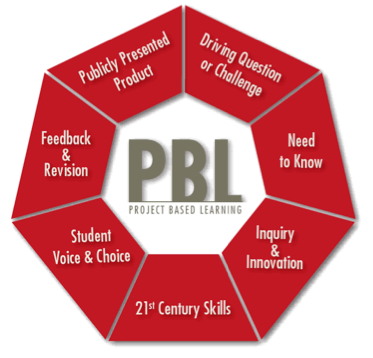
- Creating Essential Questions, Subsidiary Questions and Outcomes
- Gathering Information
- Sorting and Sifting
- Synthesizing
- Reporting
- Evaluating
Students work collaboratively in a community of inquiry to create projects that make an impact. Students think both locally and globally while designing their projects around essential questions that are relevant and challenging. They are learning 21st century skills as they grapple with new ideas, deep analysis and research. Our students leave school with pride knowing that each day they are contributing members of society.
Engaging Hands On Learning
Innovations Academy uses a constructivist learning approach in which students collaborate to learn subject matter. Constructivism views each learner as a unique individual with unique needs and backgrounds whose contribution to others is significant in the learning process. The learner is also seen as complex and multidimensional. We encourage, utilize and reward this uniqueness as an integral part of the learning process. Students are actively engaged in exploring content areas and developing skills through a hands on approach that incorporates individual time, small group time and centers. Exploring, building and doing allow students to work at levels that challenge them as individuals. We emphasize the importance of the learner being actively involved in the learning process by utilizing a variety of materials and providing many choices for learning.
Read more about Constructivist Learning Theory.
Hands-on learning is learning by doing. It involves the child in a total learning experience that enhances the child’s ability to think critically and create products that are unique to that child’s thinking and imagining. By allowing children to build, create, develop, discover etc we encourage the most effective way to learn. Samples of hands on activities:
- Exploratory Learning Centers
- Socratic Seminars
- Problem Solving
- Experimentation
- Debate
- Drama, theater, improvisation, song
- Building, creating, construction
- Play, painting, pottery
The Arts
There are many ways that people can express their learning. In order to support our students in finding their voice, actively learning self-expression and supporting them to express their learning in a variety of ways, we have a variety of programs in place. These classes can be integrated into their projects so that students learn a variety of ways to express their learning. The Explorations teachers collaborate continuously with the classroom teacher to provide a rich variety of instruction in the arts. Through this program, our students are encouraged to express their learning through movie making, documentary filming, website design, vlogging, painting, drawing, animation, graphic design, music production, reader’s theater, theater production, improvisation and more.
Fine Art: Our art teacherswork with all grade levels, rotating each trimester. Additionally, our art teachers work with our classroom teachers to incorporate artistic self-expression into projects in the classroom. We have two art teachers: one for 2-D art and one for 3-D art.
Performing Arts: Our Performing Arts instructor, Natasha, will collaborate with teachers and together integrate performing arts into the class curriculum. Natasha teaches dance, zumba, reader’s theater, acting, play writing and stage design to students. She will also be rotating to work with different classes each trimester.
Media Arts : At Innovations Academy our students produce public service announcements, audio podcasts, documentaries and other media products to demonstrate their learning in a variety of content areas. They work with experts in the field to produce final products that reflect the learning in their project.
Explorations
Arts is part of Explorations, however, we also offer other classes that enrich the education of our students.
- Nature Studies/Gardening/Environmental Science
- Fine Art (2-D and 3-D)
- Performing Arts
- Engineering/Robotics/Programming
- Physical Education including soccer, baseball, net sports, football, track & field
- Spanish (Middle School)
Mathematics
Grades K-2, 3-5 Teachers guide and support students’ invention of viable mathematical ideas by offering a variety of appropriate tasks that stimulate mathematical investigation and support. They facilitate students’ connection of abstract mathematical ideas to algorithm and number sense. They utilize elements of CGI Math in their instructional design. The curriculum we utilize to teach conceptual and algorithmic math learning is Beast Academy in grades K-5
Grades 6-8 The curriculum that is utilized for math instruction is Illustrative Math coupled with Desmos.
Additionally, STMath, a puzzle based software, may be used to support the mastery of mathematical concepts from concept to algorithm. And finally, students will utilize math in real world applications via math problem solving as well as integration in projects and inquiries.
Math Software Programs Used at I.A.
ST Math (spatial-temporal math)
Beginning in October 2013, our students have accessed the ST Math program. This is a research based, spatial-temporal visual learning mathematics software. Created to address the fact that children learn differently than schools have traditionally taught, our goal is to support our students to understand mathematical concepts not just memorize algorithms.
Motion Math: A suite of programs that our students will have access to at school and home. The main program utilized at the beginning of the year for 3-8 is Pizza. Motion Math: Pizza! addresses basic money and economic concepts as well as Common Core Math Standards targeting fluent multiplication and addition, proportions, multi-step word problems, and interpreting data.
Thinking Blocks: Thinking Blocks is an interactive tool that helps students model math word problems.
Additionally, there are many enrichment classes held before and after school. Instruction in yoga, sports, music, chess and cooking vary throughout the school year. Visit the Extended Care section of the website for details.
Human Sexuality Education
Innovations Academy meets the qualifications for the California Healthy Youth Act by providing Health Education instruction during 7th grade using the 3Rs curriculum: Rights, Respect, Responsibility. See the lessons below:
- Lesson 1: Blue is for Boys, Pink is for Girls
- Lesson 2: Sexual Orientation, Behavior and Identity
- Lesson 3: Everybody’s Got Body Parts
- Lesson 4: Reproduction Basics
- Lesson 5: STI Information
- Lesson 6: HIV and AIDS
- Lesson 7: Birth Control Basics
- Lesson 8: Pregnancy and Pregnancy Options
- Lesson 9: Stopping Bullying, Sexual Abuse and Assault/The Impact of Alcohol & Drugs on Sexual Behavior
- Lesson 10: Making SMART Choices
- Lesson 11: Assertive Behaviors about Sexual Behaviors/Consent
No Meaningless Homework Policy
According to much research there is almost no evidence that homework helps elementary school students achieve academic success and little more that it helps older students. Common sense tells us that homework often causes family problems and takes time away from valuable learning experiences that can happen before and after school hours. Over the past few years we have found that our no meaningless homework policy has allowed our students to read more at home, enjoy more loving family time, experience fewer fights with their parents. spend more time outdoors playing, give them time to practice skills that they need to address, take more enrichment classes and be less stressed. This allows parents and children to fill that space in whatever way they feel is most appropriate. If you would like to read more about this topic you may find the article, Rethinking Homework, by Alfie Kohn, to be helpful.
Student Led Conferences
Innovations Academy holds Student Led Conferences once per year. They take the place of Parent-Teacher conferences after the first six weeks of school. Student Led Conferences are a time when the teacher, parents and student take a look at the work and take time to set goals. Students lead parents and teachers through a discussion that involves goal setting, portfolio review and current strengths and challenges. This format helps students take responsibility for their learning.
Portfolio Review
Our report cards are odd. Let’s just start there. But they are valuable once you put the time in to review them. Parents deserve to understand their child(ren)’s strengths and challenges since they are the most important influences in their child(ren)’s life. Our report cards are ties to portfolios of work. Each work item receives points and the points are accumulated to form the report card “grade.” For parents to understand the report card, they must review the portfolio work. Portfolios are available in the classroom to throughout the year so that parents can review the work thereby evaluating their child’s learning via portfolio review.
Exhibition Nights
Twice each school year our students formally exhibit their work to each other, their parents and the community at large. We consider this evaluation of work more important than a report card. Whether you are a parent or community member interested in project based learning, you are invited to come for the excitement.
See our most recent Exhibition of Student Learning Program Booklet HERE
Presentations of Learning (POL)
Students present their learning regularly in class. Additionally, they give presentations of their learning at the end of each project. Our formal ‘Presentations of Learning’ are given at the end of the school year. These presentations serve many functions that are integral to the mission of our school: to reflect upon one’s learning, to improve one’s public speaking skills, and to revise one’s work so that it is worthy of public presentation. The presentations consist of students talking about their personal and academic growth over the semester, and highlighting several pieces of work as evidence of that growth. Students present to an audience of peers, adults and family members.